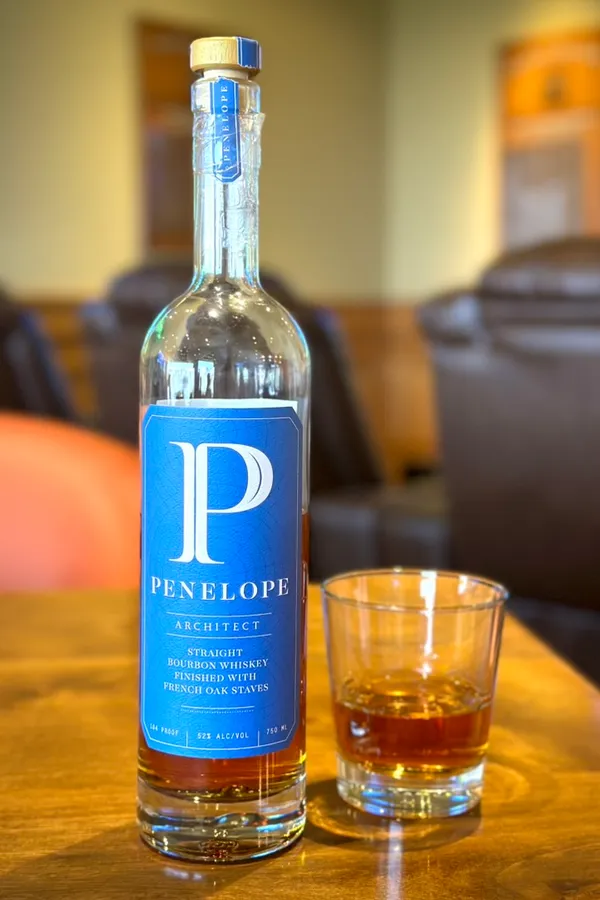
Penelope Architect Build 9 Review - The best Penelope?
Overview: The Penelope Architect series is built around a concept that sounds more complicated than it tastes: three different MGP bourbon distillates blended together, then finished with French oak staves selected using Tonnellerie Radoux’s OakScan® process. That’s a mouthful. The short version is that this is a 4-year, 104-proof MGP-sourced bourbon with a wood finish, and it’s the ninth iteration of Penelope’s ongoing experiment in precision blending.
For context: Penelope is sourced from MGP in Lawrenceburg, Indiana, which is the same facility behind dozens of well-regarded brands. What Penelope is doing differently is blending multiple MGP mashbills together rather than selecting a single barrel or a single recipe. The Architect series adds a secondary wood stave treatment on top of that, which takes it one step further. It’s a lot of process for a 4-year bourbon, and on previous Penelope bottles I’ve wondered whether the complexity justified the marketing. Build 9 is the one that convinced me they’re onto something.
How I Found It: Picked this up on a recommendation — not a club pull, just someone whose taste I trust telling me Build 9 was worth grabbing. I’ve tried several Penelope expressions over the years with mixed results; the blended approach and young age statement have kept them from becoming regular rotational bottles for me. This one changed that assessment.
Age: 4 Years
Proof: 104 (52% ABV)
Mashbill: Undisclosed blend of three MGP distillates:
| MGP Recipe | Composition |
|---|---|
| High Wheat Bourbon | 51% corn, 45% wheat, 4% malted barley |
| Standard Rye Bourbon | 75% corn, 21% rye, 4% malted barley |
| High Corn Bourbon | 99% corn, 1% malted barley |
The exact proportions are proprietary. The result is a four-grain profile — corn, wheat, rye, and malted barley all present — which is unusual and explains some of the complexity you get for a 4-year expression.
Secondary Finish: French oak staves (Tonnellerie Radoux OakScan® selection)
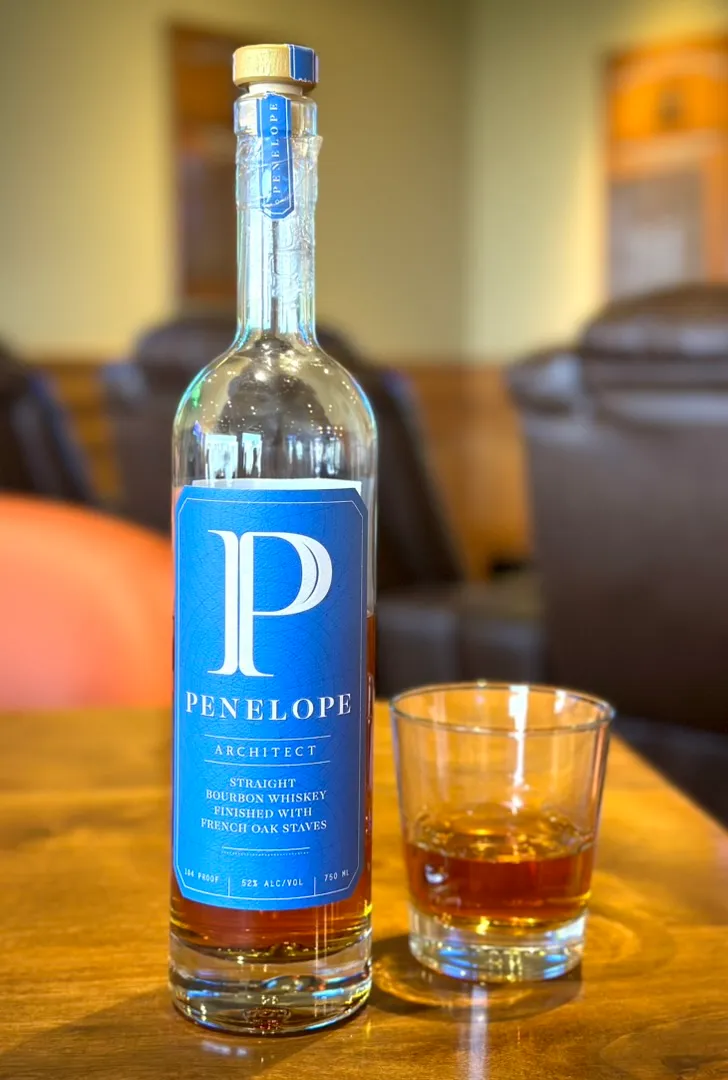
Nose: Vanilla frosting and lightly toasted marshmallows up front, complemented by white pepper and a warm oak presence. There’s a hint of youthfulness — it doesn’t quite have the density you’d get from a 6–8 year bourbon — but the French oak stave treatment softens the raw edges well. Inviting for a 104-proof bottle.
Palate: Surprisingly soft on entry, given the proof. Caramel and cinnamon lead, with a touch of dark cherry mid-palate. The mouthfeel is pleasingly viscous — thicker than you’d expect — which is doing a lot of work to make the youth of this bourbon feel more complete. The sweet oak from the French stave finish is the dominant note and it works well here. With attention you can pick up some subtle blackberry underneath. The four-grain blend gives this more complexity than a single-recipe MGP bottle typically shows at this age.
Finish: The sweet oak continues into the finish, where the sweetness shifts toward toffee and caramel, and the darker fruit notes become more prominent — blackberry and a hint of coffee. The length is better than a 4-year bourbon has any right to deliver, which is the combination of the four-grain blend and the secondary stave treatment doing their jobs. It’s a finish that makes you take the 4-year age statement seriously rather than treating it as a liability.
Is the OakScan Process Doing Something Real?
There’s a fair amount of skepticism in the bourbon community about finishing processes and proprietary wood selection systems — a lot of it sounds like marketing language for a modest intervention. The Radoux OakScan system uses ultrasound and density measurements to select staves with specific grain structures, which allegedly predicts flavor contribution more reliably than visual inspection alone. Whether the science is as precise as the marketing suggests, I can’t say. What I can say is that the wood integration on Build 9 is better than what I’ve experienced on earlier Penelope expressions — the French oak reads as genuinely woven into the profile rather than tacked on at the end.
How It Compares to Other Penelope Releases
I’ve had several expressions from the Penelope lineup, including the Penelope Toasted Series, and Build 9 is the one that sticks. The Toasted Series is fine but straightforward; the Architect series adds a layer of intentionality through the blending that makes the result more interesting. Build 9 in particular feels like a mature iteration of the concept — you can taste the refinement compared to earlier builds.
Final Thoughts: Penelope Architect Build 9 defies the “it’s only 4 years old” objection more convincingly than most young bourbons. The combination of the multi-mashbill blend and the French oak stave finish produces something that drinks older than its age statement suggests. At its price point (~$55–65), it’s competitive with other finished bourbons in the same range. This is the best Penelope I’ve had, and that’s saying more than it used to.
If You Liked This, Try…
- Elijah Craig Toasted Barrel — A more straightforward finished bourbon comparison point: standard Heaven Hill mashbill, toasted new oak secondary barrel, $40. Less complex than the Architect blend, but a cleaner illustration of what a wood finish adds.
- Maker’s Mark Private Selection “Golden Hour” — Another intentional stave-finishing approach, this time from Maker’s Mark with a customized stave profile selected specifically for that barrel. Higher proof, more complexity, more expensive — but the same philosophy of using secondary wood to shape the final profile.
Rating: Middle Shelf — Rating system explained